
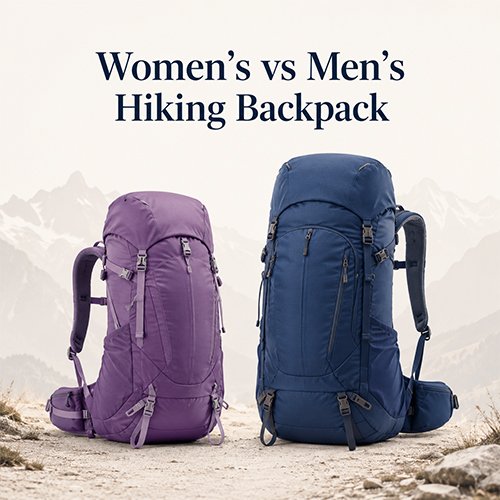
Most brands offer hiking backpacks in a standard or unisex fit, but some of the top names in outdoor gear — Osprey, Deuter, and Gregory among them — also produce gender-specific versions. This isn’t about stereotypes. It’s about anatomy. Men and women carry weight differently, and a well-designed pack accounts for those differences to improve comfort, balance, and load transfer.
The differences between men’s and women’s hiking backpacks show up in several key areas: pack length, shoulder strap spacing, hip belt shape and position, and overall volume. Here’s a closer look at what actually sets them apart.
Pack Length, Sized to Your Torso
Women’s average torso length runs 16.5–19.0 inches (42–48 cm), while men’s averages 18.0–20.5 inches (46–52 cm). In other words, women tend to have shorter torsos relative to their overall height — and pack design reflects that.
Most modern hiking backpacks come in S, M, and L sizes based on torso length, measured from the C7 vertebra at the base of your neck down to the top of your hip bones (iliac crest). If you don’t have a tape measure handy, you can estimate your torso length using your height: height x 0.27, keeping in mind this method can be off by up to 2 inches (5 cm).
The table below gives average torso lengths by height for both men and women:
| Height | Women Torso | Pack Size | Men Torso | Pack Size |
| 5’0″ | 16.2″ | XS | 17.0″ | S |
| 5’1″ | 16.5″ | XS | 17.3″ | S |
| 5’2″ | 16.7″ | S | 17.5″ | S |
| 5’3″ | 17.0″ | S | 17.8″ | M |
| 5’4″ | 17.3″ | S | 18.1″ | M |
| 5’5″ | 17.6″ | M | 18.4″ | M |
| 5’6″ | 17.8″ | M | 18.6″ | M |
| 5’7″ | 18.1″ | M | 18.9″ | M |
| 5’8″ | 18.4″ | M | 19.2″ | L |
| 5’9″ | 18.6″ | L | 19.4″ | L |
| 5’10” | 18.9″ | L | 19.7″ | L |
| 5’11” | 19.2″ | L | 20.0″ | L |
| 6’0″ | 19.4″ | L | 20.2″ | L |
| 6’1″ | 19.7″ | XL | 20.5″ | XL |
| 6’2″ | 20.0″ | XL | 20.8″ | XL |
| 6’3″ | 20.3″ | XL | 21.1″ | XL |
| 6’4″ | 20.5″ | XL | 21.3″ | XL |
| 6’5″ | 20.8″ | XL | 21.6″ | XL |
| 6’6″ | 21.1″ | XL | 21.9″ | XL |
| 6’7″ | 21.3″ | XL | 22.1″ | XL |
| 6’8″ | 21.6″ | XL | 22.4″ | XL |
| 6’9″ | 21.9″ | XL | 22.7″ | XL |
| 6’10” | 22.1″ | XL | 22.9″ | XL |
| 6’11” | 22.4″ | XL | 23.2″ | XL |
Note: If your pack’s back panel is too long, weight sits too low on your back. The hip belt rides up onto your waist instead of your hips — and when that happens, you lose the load transfer that makes carrying 30+ lbs manageable.
Shoulder Straps and Sternum Buckle
On men’s hiking backpacks, shoulder straps typically run straight down from the pack. Women’s straps curve outward in an S-shape and angle inward near the top to follow narrower shoulder lines. The sternum buckle on women’s packs also sits higher — at or above bust level — compared to men’s, where it clips lower across the chest.
Both design differences serve the same purpose: reducing pressure on the chest, improving breathing comfort, and keeping the straps seated correctly throughout the day. Both are adjustable to accommodate a range of body types.
Hip Belt
Ideally, about 80% of your hiking backpack’s weight should ride on your hips, not your shoulders. The hip belt is what makes that possible — and it needs to fit your anatomy to work properly.
Women’s hip belts are wider and shaped differently to match the female pelvic structure. Women typically have a wider pelvis relative to their shoulders, with hip bones that flare outward at a different angle. To accommodate this, women’s hiking backpack hip belts often taper inward at the top and flare outward at the bottom, following the natural curve of the hips and waist. The front padding is also trimmed shorter to give women with a smaller waist more room to adjust.
Men’s hip belts, by contrast, are wider and thicker overall, built to handle heavier loads with more structural support. A contoured or three-dimensional shape helps the belt sit flush against the hips during movement — climbing, descending, and side-to-side travel — reducing pack sway and friction.
Volume and Weight
Because women’s hiking backpacks are built on a smaller frame, they typically use less material — which means slightly lower volume and lighter overall weight compared to equivalent men’s models. This doesn’t affect performance. That said, it’s not a hard rule: the Deuter Futura Air Trek 45+10 SL (women’s) and the Deuter Futura Air Trek 50+10 (men’s) are a good example of how these differences play out across specific models.
Pocket Count
Women hiking often carry a broader range of gear alongside the essentials — camera, sunscreen, sunglasses, tissues, a change of clothes. Some women’s hiking backpacks reflect this with additional pockets and organizational features to make sorting and accessing gear easier on the trail.
What Happens When Your Hiking Backpack Doesn’t Fit
Whether you’re buying a men’s or women’s hiking backpack, fit is everything. A poorly fitting pack can cause:
- Shoulder straps that dig in or slip off
- A sternum buckle that presses on the chest and restricts breathing
- A rearward or downward weight shift that creates a pulling sensation
- Pack sway with every step
- A hip belt that rides up onto the waist instead of locking onto the hips
- Uneven load distribution that tires one shoulder faster than the other
What to Look for in a Custom Hiking Backpack
For brands developing custom men’s or women’s hiking backpacks, here’s what matters most.
Durable Materials
High-quality, purpose-built fabrics extend pack life. Ripstop nylon and Cordura are go-to choices for abrasion and tear resistance on the trail. For added weather protection, look for fabrics with a PU, PVC, or TPU waterproof coating.
Weight and Capacity
A lighterhiking backpack means less strain on the body and a more comfortable day on trail. Thoughtful material selection and smart design can meaningfully reduce dead weight without sacrificing durability.
Load-Bearing Strength
A hiking backpack should comfortably carry 20–30% of the wearer’s body weight. To keep things from failing under load, focus on:
- A rigid internal frame to distribute heavy loads
- Double-stitched seams at high-stress points
- A reinforced base for ground contact and abrasion resistance
Comfort and Adjustability
Ventilated back panels, padded shoulder straps, adjustable hip belts, and sternum buckles should all be tunable to fit a range of body types. Breathable padding keeps airflow moving and prevents heat buildup during long carries. A supportive hip belt and load lifter straps are also worth prioritizing — they make a real difference in how stable and effortless a loaded pack feels.
Pockets and Organization
Well-placed pockets turn a good pack into a great one. Hip belt pockets for snacks and a phone, shoulder strap pockets for a water bottle, quick-access exterior pockets for a rain jacket or first aid kit, and internal dividers for organized packing — each adds practical value for the user on trail.
Hydration System
Staying hydrated on the trail is non-negotiable. Most custom hiking backpacks include a dedicated hydration sleeve sized for a standard reservoir, with a routing port for the drink tube. Some designs also incorporate a soft silicone bite valve for easier hands-free drinking.
In summary, men’s and women’s hiking backpacks differ in design — but the goal is the same: a comfortable, stable carry for everyone on the trail. Whether you’re looking to develop a men’s pack, a women’s pack, or a standard unisex model, our OEM/ODM service can help you bring it to life at scale. Have a specific design in mind? Let us know.