
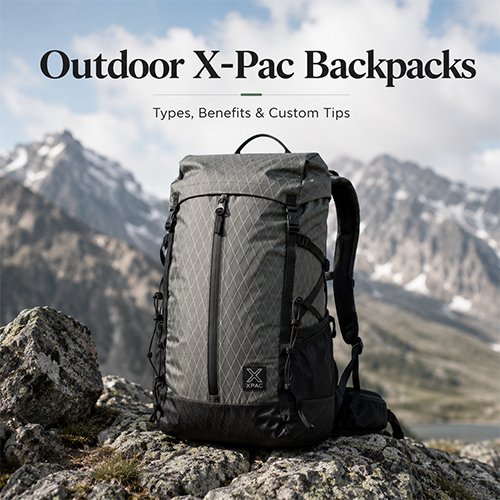
At USL, many of our popular custom outdoor backpack project suse X-Pac fabric. It is because X-Pac is a high-performance technical fabric that checks every box: lightweight, waterproof, UV-resistant, and tough enough to handle abrasion, punctures, and tears. For outdoor backpacks, it’s hard to beat.
What is X-Pac Fabric?
X-Pac fabric was developed by Dimension-Polyant and was initially used as a canvas for nautical racing. It remains strong and durable, impervious to wear and tear, whether exposed to intense sunlight or rough seas.
That durability comes from its multi-layer laminated construction. According to Dimension-Polyant, X-Pac consists of four distinct layers:
- Face fabric. Typically 210D to 500D nylon or polyester, this outer layer handles abrasion resistance and defines the look of the fabric.
- X-PLY grid. The diagonal grid layer gives X-Pac its signature visual pattern while reinforcing the fabric against tearing and deformation.
- PET film. A waterproof, low-stretch film that blocks moisture from penetrating the material. It also helps the backpack hold its shape under load.
- Woven backing. The inner layer strengthens seam integrity and adds another layer of abrasion resistance from the inside.
So outdoor X-Pac backpacks are very lightweight and sturdy, maintaining their shape well and resisting collapse. Compared to traditional fabrics, its waterproof performance effectively protects the contents of the backpack, and the entire bag doesn’t become heavier when wet.
The Advantages of Outdoor X-Pac Backpacks
Outdoor backpack brands choose X-Pac not just for its performance credentials, but because their customers actively seek it out. Buyers who understand materials are willing to pay a premium for gear that delivers. Here’s what makes outdoor X-Pac backpacks worth it:
Lightweight & Strong
The primary reason for the market demand for outdoor X-Pac backpacks is their lightweight design. On long treks, every ounce counts, so choose an outdoor backpack that balances strength and lightweight design. Compared to many Denier’s Cordura backpacks, the X-Pac is significantly lighter. Cordura backpacks are 59% heavier than X-Pacs of the same surface area.
Furthermore, the X-Pac’s lightweight design doesn’t sacrifice strength. Its abrasion and puncture resistance allows for the storage of sharp tools, outdoor gear, and essentials, making it ideal for activities like water racing, mountaineering, and hiking. This is why X-Pac fabric is increasingly being chosen for ultralight hiking backpacks, EDC bags, and luggage.
100% Waterproof
X-Pac’s PET film layer prevents moisture from penetrating the material, keeping items stored in an X-Pac backpack dry and hygienic. Thanks to the hydrophobic nature of X-Pac fabric, the backpack won’t become heavier due to water absorption, and it’s easy to clean and dry, preventing mold and odor growth.
More importantly, the surface of the outdoor X-Pac backpack will not age, peel, or flake due to repeated water absorption and drying, thus extending the backpack’s lifespan.
USL combines X-Pac with YKK zippers and taped seams, achieving complete waterproofing. Whether you’re caught in a downpour or crossing a stream, your gear stays dry in outdoor X-Pac backpacks.
Style
Another major reason for the outdoor X-Pac backpack’s market popularity is its striking and sleek design. The X-shaped diamond pattern is its most prominent feature, very simple and clean, favored by many outdoor enthusiasts. Furthermore, the X-Pac outdoor backpack offers some UV protection and is not prone to fading even in strong sunlight.
Based on the X-Pac outdoor backpack’s style, companies like GoRuck and Aer sell some of their X-Pac backpack series as near-luxury products.
X-Pac Outdoor Backpack Types
The Outdoor X-Pac Backpack does not use a single fabric specification; Dimension-Polyant has launched multiple models for different usage scenarios. Here are some common types:
| Model | Series | Face fabric | Weight | Key characteristics | Best for |
| VX07 | Lightweight | 70D nylon | Lightest | Minimal weight for ultralight backpack builds | Ultralight hiking gear |
| VX21 | Standard | 210D nylon | 5.9 oz/yd² | The most popular X-Pac backpack fabric — optimal balance of weight and durability | Everyday carry, travel, outdoor backpacks |
| VX25 | Standard | 250D polyester | Lighter than VX21 | 100% polyester construction; available in high-visibility colorways | High-visibility outdoor backpacks |
| VX42 | Heavy duty | 420D nylon | Heavier | Superior abrasion resistance — the go-to for X-Pac heavy duty backpack applications | Heavy load carry, urban commuting |
| X50 | Heavy duty | 500D Cordura | Heaviest | Cordura face fabric delivers the toughest X-Pac material for extreme-use scenarios | Tactical gear, extreme-use packs |
| RX30 | Eco | Recycled polyester | Similar to VX21 | 100% recycled inputs — a sustainable backpack fabric without sacrificing performance | Eco-conscious everyday carry |
| UX10 | Specialist | 100D Ultra-PE | Ultra-light | Exceptional strength-to-weight ratio — a premium lightweight backpack material for technical builds | High-performance ultralight packs |
All X-Pac fabric variants are manufactured in specialized facilities in the US and Germany, with consistent quality control across every production run — making them the material of choice for premium outdoor backpack brands worldwide.
Tips for Customizing an Outdoor X-Pac Backpack
The difficulty in customizing an outdoor X-Pac backpack lies not in sourcing the fabric, but in the design complexity and manufacturing process.
Structural Design – When designing an outdoor X-Pac backpack, minimize areas that require frequent folding and compression, such as compression side pockets and right-angle folds. The PET film of X-Pac fabric lacks elasticity; prolonged folding will create permanent creases, leading to a loss of waterproof performance.
Production Technology – The laminated structure of X-Pac fabric is relatively stiff. Sewing requires adjusting the fabric feed speed and stitch spacing, which necessitates factories with experience in customizing X-Pac backpacks to minimize rework.
Waterproof Seam Technology – X-Pac fabric is inherently waterproof, but simple stitching can allow water to seep in through needle holes. Only by using heat-sealed seams and YKK waterproof zippers can an outdoor X-Pac backpack achieve 100% waterproofing.
At USL, we don’t pursue the lowest possible cost. We are committed to creating high-performance, durable outdoor backpacks. To date, we have completed over 550 X-Pac backpack customization projects. Whether you want to customize hiking backpacks, adventure backpacks, mountaineering backpacks, urban commuter bags, or cycling bags using X-Pac fabric, our OEM/ODM services can fully support your customization projects.