
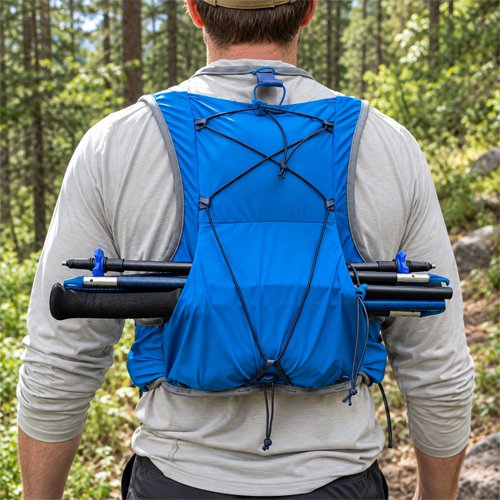
Trail running hydration vests are typically equipped with attachment points for trekking poles, allowing runners to use them when navigating rugged mountain terrain.
During the product development phase, the placement of these attachment points is determined by specific user requirements or the overall design. Depending on the model, poles can be carried diagonally across the waist, horizontally across the back, or vertically on the front. To properly secure your trekking poles, you must first identify the specific attachment system featured on your vest.
Evaluating the Hydration Vest’s Attachment System
Before attempting to attach your poles, examine the hudration vest’s carrying system to ensure a proper setup. Key aspects to check include:
- Designated attachment features, such as loops, cords, or pockets.
- Compatibility with external pole quivers.
- Supported pole types and size specifications.
- Presence of any detachable cords or accessories.
- Available carrying configurations (e.g., front-mounted, horizontal back-carry, diagonal side-carry, or the use of a dedicated quiver).
Common Carrying Methods
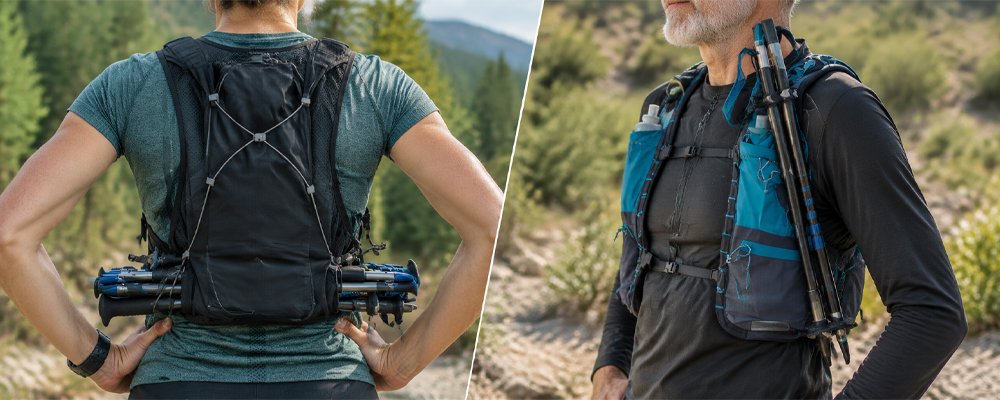
There are two primary ways to carry trekking poles on a trail running hydration vest: using the vest’s integrated system or utilizing separate, add-on accessories.
Integrated Attachment Systems
Many hydration vests come with built-in components—such as elastic cords, hooks, or specialized pockets—designed to secure trekking poles. A common and versatile design involves using detachable elastic cords paired with hooks; this allows poles to be attached to either the front or back of the vest, supporting various orientations such as vertical or horizontal positioning.
Some vests feature an elastic band or a continuous sleeve across the lower back, allowing you to slide in and secure folded trekking poles. Carrying poles at the lower back helps lower your center of gravity, makes them easier and more natural to access, and ensures they do not interfere with the space reserved for hydration flasks on the front of the vest.
Using a Dedicated Quiver/Pole Holder
In addition to purpose-built trekking pole holders, a “quiver”—typically worn behind the shoulder—can also be used to store folded trekking poles. Adding a quiver or a dedicated pole holder is useful when your running vest lacks suitable attachment points, or when you need faster access to your poles.
If you only need to carry your poles for long stretches without frequent removal or storage, the vest’s built-in attachment system is sufficient. However, if you frequently switch between using and stowing your poles, a quiver offers great convenience by keeping the opening easily accessible.
How to Attach Trekking Poles to a Trail Running Hydration Vest
There are two main methods: using the vest’s integrated attachment system or adding a dedicated quiver.
Using Integrated Attachment Systems
- Step 1: Collapse the trekking poles according to the manufacturer’s instructions, secure the folded sections, and tuck away the wrist straps.
- Step 2: Place the folded poles into the designated pole sleeves or loops. Check whether the poles should be carried together or separated on either side of the vest.
- Step 3: Tighten the cords to ensure the poles are held firmly in place, then secure the cord locks. Be careful not to overtighten, as this could cause the cords to snap or the vest to deform.
- Step 4: Once secured and the vest is fully loaded, test the fit. Swing your arms, turn your head, bend over, and reach for the poles to ensure the setup is ergonomic and functional.
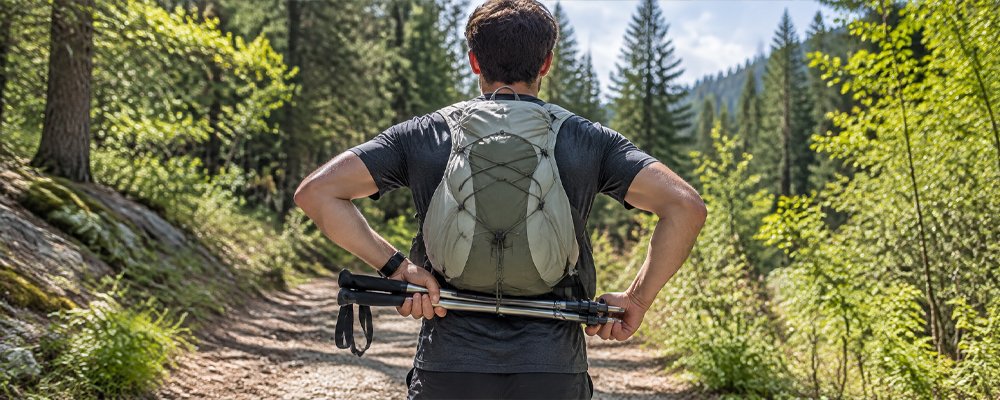
Using an Add-on Quiver
Ensure the quiver is compatible with your running vest before proceeding. Never attempt to improvise attachments using unsupported mesh, bottle-retention cords, or chest buckles.
- Step 1: Connect all necessary attachment points to secure the quiver to the vest.
- Step 2: Insert the folded trekking poles into the quiver.
- Step 3: Tighten the included retention cords to ensure the poles remain firmly in place within the quiver.
- Step 4: Load the vest with your gear and make any necessary adjustments to ensure it does not become misshapen or restrict your movement.

Note that some quivers may leave parts of the trekking poles exposed; when securing them, ensure they cannot slide out or shift around while you are in motion. If a suitable quiver isn’t available, a dedicated trekking pole belt or a trail running hydration vest may be a more practical choice. For guidance on choosing the right running vest, check out our dedicated guide.
Simply practicing how to attach your trekking poles to your running hydration vest isn’t enough for a trail race; you also need to master the skill of deploying and stowing them while running or walking. When practicing, ensure your vest is fully loaded with your gear, and test whether the pole wrist straps are prone to snagging on cords or other attachments—and confirm that you can easily re-fasten all the securing clips after stowing the poles.
Are you developing a trail running hydration vest for your outdoor brand? Get in touch with USL to learn about our custom hydration vest solutions.